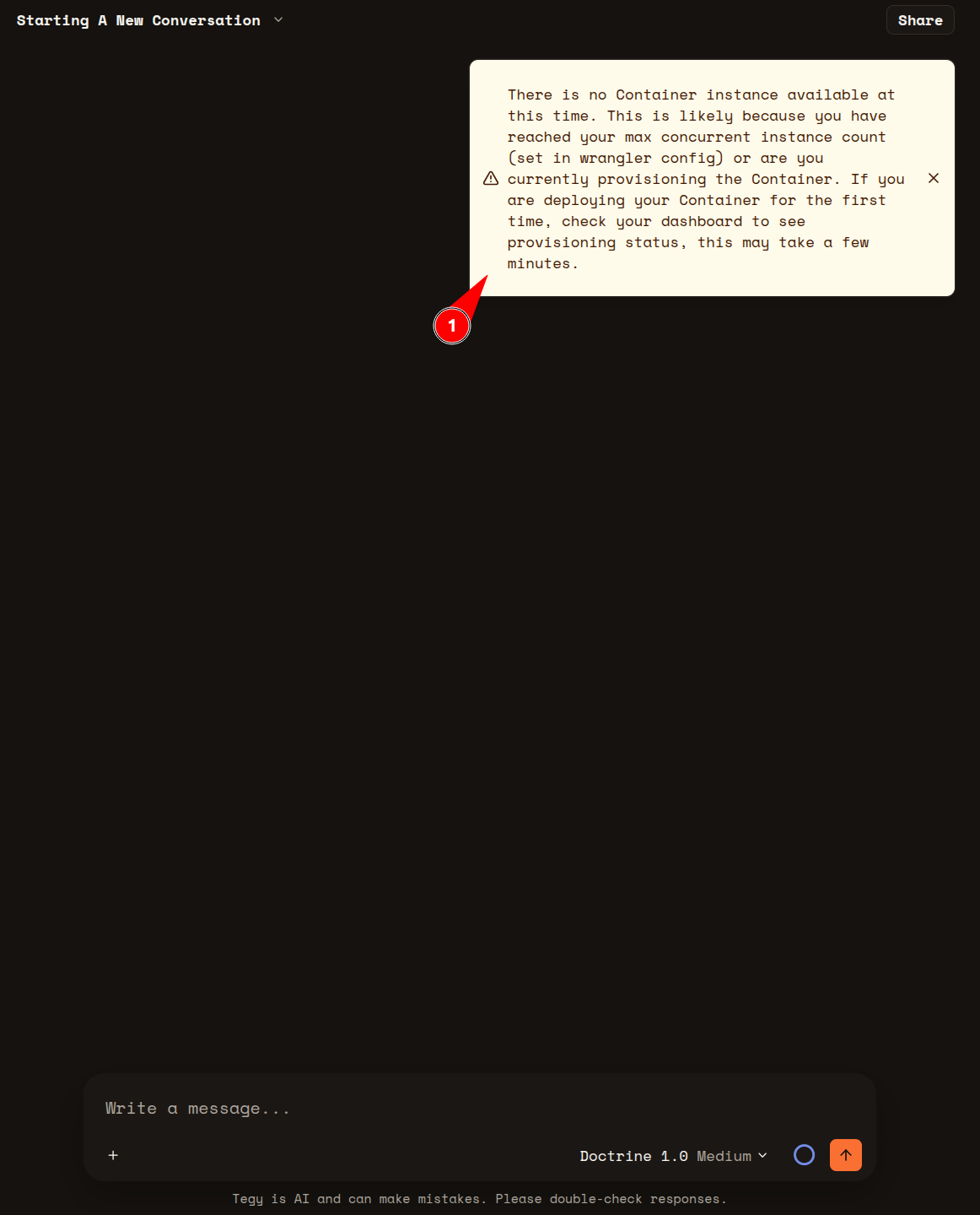
Before: 100/100 live
A new turn could not acquire a Container instance and surfaced
the provider's raw capacity response.
Tegy's draft-chat prewarm path kept Cloudflare Containers alive after their work was done. This report separates observed usage from estimated incident excess, shows the cost curve, and records the shipped recovery.
The incident was noticeable, not catastrophic: approximately $105.01 of Containers resource charges were observed from 12 June through early 13 July, of which approximately $95.99 is estimated above Tegy's pre-growth baseline. Left at the 100-instance cap, idle memory and disk alone would have approached $24/day or $720/month before active CPU.
Monthly included usage applied to June and July.
Usage above the 12–27 June daily baseline.
No free instance remained for a new chat turn.
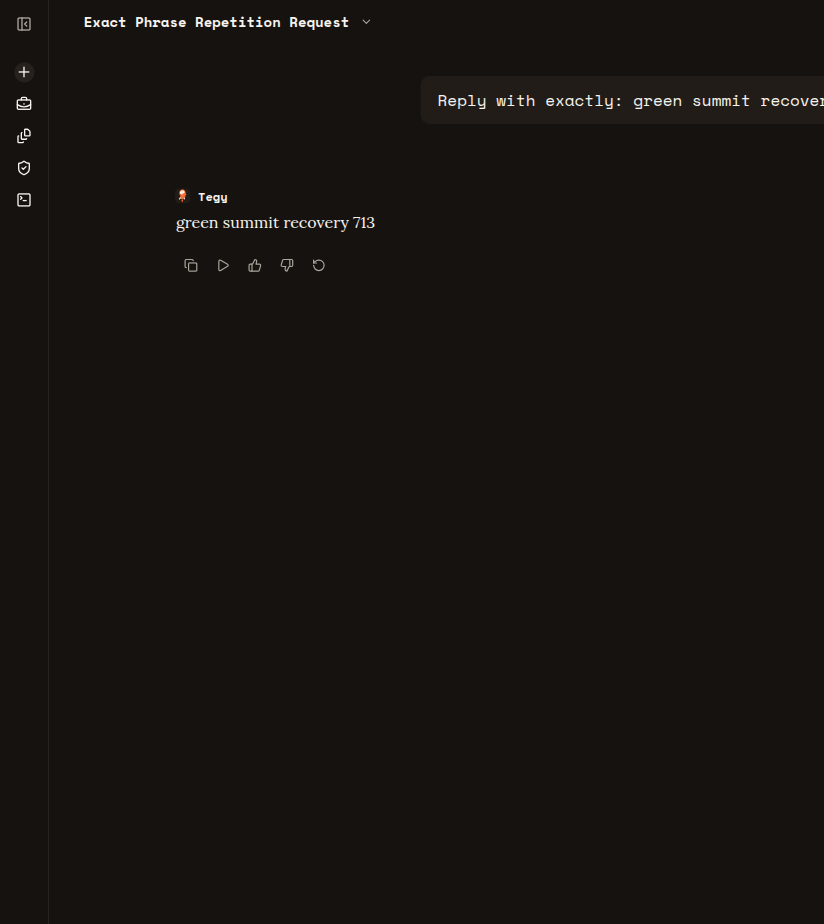
2 active, 7 healthy, 0 failed at the final rollout sample.
Daily allocated memory is the clearest proxy for leaked wall time because every Tegy container reserves 1 GiB while it is alive. The baseline averaged 27.2 GiB-hours/day through 27 June; growth begins sharply on 28 June and peaks at 1,723.5 GiB-hours on 12 July. The 13 July point is partial and includes the rollout recovery window.
* 13 July is a partial day queried at 04:49 UTC. Unit: provisioned GiB-hours, not application RSS.
These calculations use Cloudflare's
containersUsageAdaptiveGroups data—the same
billing-estimation dataset that populates the dashboard—and official
Workers Paid rates. Figures are estimates, not a finalized invoice.
| Period | CPU | Memory | Disk | Estimated charge |
|---|---|---|---|---|
| 12–30 June | 97,383.56 sec | 1,300.28 GiB-hr | 5,201.10 GB-hr | $14.24 |
| 1–13 July* | 509,935.23 sec | 8,123.27 GiB-hr | 32,493.09 GB-hr | $90.77 |
| Total | 607,318.79 sec | 9,423.55 GiB-hr | 37,694.19 GB-hr | $105.01 |
The billing query returned 607,309.98 CPU-seconds and 9,423.38 GiB-hours in the initial raw aggregation. The month-split rerun shown above differed by less than one minute of live ingestion; dollar totals are unchanged at displayed precision.
After June's included allocation: $1.50 CPU + $11.48 memory + $1.26 disk.
$1.50 + $11.48 + $1.26 = $14.24After July's included allocation: $9.75 CPU + $72.88 memory + $8.14 disk.
$9.75 + $72.88 + $8.14 = $90.77The counterfactual uses Tegy's observed 12–27 June average as the pre-growth baseline, then subtracts that daily rate from the 28 June–12 July growth window. This avoids calling all container usage “waste,” while acknowledging that a perfect counterfactual invoice is impossible after the fact.
| Resource | Excess above baseline | Rate | Gross excess cost |
|---|---|---|---|
| Active CPU | 537,959.08 vCPU-sec | $0.000020/sec | $10.76 |
| Provisioned memory | 8,515.91 GiB-hr | $0.009/GiB-hr | $76.64 |
| Provisioned disk | 34,063.62 GB-hr | $0.000252/GB-hr | $8.58 |
| Estimated incident excess | $95.99 | ||
At the 100-instance cap, 100 basic instances reserve 100 GiB memory and 400 GB disk. Keeping that fleet alive for a full day costs about $21.60 memory + $2.42 disk before active CPU.
CPU is billed on active usage rather than provisioned capacity, egress was only 1.73 GB and remained well inside the included allotment, and the fleet was fixed before a full month at the cap.
The same failure that created the cost curve exhausted all available instances and returned a raw Cloudflare 503 to new chats. The shipped fix restored production turns and released idle capacity.
The new-chat route eagerly prewarmed a unique container. The Worker awaited the health response but did not consume or cancel its body, leaving the Containers helper's in-flight request counter above zero. Activity expiry therefore kept renewing instead of stopping the instance.
Prewarm now starts only after user intent, its response body is always drained, idle timeout is five minutes, and activity expiry explicitly stops the process. Capacity failures are normalized to a retryable JSON 503 rather than raw provider copy.
8b37f4b5….
Usage came from Cloudflare Analytics GraphQL
containersUsageAdaptiveGroups, filtered to Tegy's
Containers application and grouped daily from 12 June through 13
July.
Workers Paid includes 25 GiB-hours memory, 375 vCPU-minutes, and 200 GB-hours disk per month. Overage rates are $0.0000025/GiB-second, $0.000020/vCPU-second, and $0.00000007/GB-second.
This is an engineering estimate, not a Cloudflare invoice. It excludes the ordinary $5 Workers Paid base plan, taxes, contractual credits or discounts, and small adjacent Worker, Durable Object, or log charges. Calendar-month allowances were applied separately; a different invoice-cycle boundary would change the result by less than approximately $1. Network egress remained below the included allotment. The baseline method may attribute some legitimate growth to the incident or miss legitimate activity embedded in the baseline.
| Date | GiB-hours | Date | GiB-hours |
|---|---|---|---|
| 12 Jun | 11.55 | 28 Jun | 225.88 |
| 13 Jun | 7.79 | 29 Jun | 332.37 |
| 14 Jun | 21.13 | 30 Jun | 306.78 |
| 15 Jun | 26.43 | 1 Jul | 647.43 |
| 16 Jun | 9.02 | 2 Jul | 420.59 |
| 17 Jun | 23.82 | 3 Jul | 517.43 |
| 18 Jun | 27.91 | 4 Jul | 817.78 |
| 19 Jun | 41.41 | 5 Jul | 424.37 |
| 20 Jun | 26.73 | 6 Jul | 967.46 |
| 21 Jun | 26.51 | 7 Jul | 570.38 |
| 22 Jun | 26.16 | 8 Jul | 384.04 |
| 23 Jun | 48.17 | 9 Jul | 236.63 |
| 24 Jun | 28.27 | 10 Jul | 441.86 |
| 25 Jun | 35.46 | 11 Jul | 907.41 |
| 26 Jun | 35.34 | 12 Jul | 1,723.53 |
| 27 Jun | 39.53 | 13 Jul* | 64.20 |
The journey monitor detected user-visible failure only after the fleet was exhausted. On 13 July, Tegy shipped three independent guardrails: a hard blast-radius limit, an application-specific early warning, and an account-wide spend backstop.
Production max_instances is now 40,
down from 100 while Tegy is pre-launch. That leaves headroom above
the observed development fleet but bounds idle memory-and-disk
exposure near $9.61/day. The live container application reported
the 40-instance ceiling after rollout.
A scheduled Worker probe now reads billing-grade container usage
every 15 minutes. It warns in Discord at
20 live-equivalent instances, alerts critically
at 32 (80% of the cap), reports recovery, and
alerts immediately on any
container_capacity_unavailable response.
Three account-wide Cloudflare budget alerts are active at $10 warning, $25 action, and $50 critical per billing cycle. Each routes to the shared Tegy billing recipient rather than one operator.
The shipped container.started,
container.activity_expired, and
container.stopped events can support a later alert
when starts materially outpace stops beyond the five-minute idle
window. A growing unmatched-start count is the leak signal this
incident lacked.
Yellow: investigate at 20 live-equivalent instances. Red: stop nonessential tests and inspect lifecycle logs at 32. Capacity: keep the hard cap at 40 until launch planning explicitly raises it. Budget alerts are a daily financial backstop, not a substitute for the 15-minute operational probe.
Production evidence: Worker version
6cfa4e36-b677-4e8b-8128-536273919e64 deployed with the
*/15 * * * * trigger; the live analytics/Discord probe
succeeded at 21.1 live-equivalent instances; and the remote D1 alert
state migration completed. Implementation:
PR #1001.
Cloudflare budget alerts are informational, account-wide, and evaluated from billing-period spend; they do not pause usage. Archiving old chats remains optional product/data-retention work because history is durable in D1/R2 and does not require a live container.